Service
Timeline
Year

(Overview)
Concept & Research
I condensed the briefing of the digital consulting group into a Lean Canvas with primary and secondary target groups, four strategic goals and a scope split into mandatory and optional features. Targeted references per problem guided the work: borger.dk, hel.fi and leipzig.de for services, goteborg.com, vy.no and myswitzerland.com for imagery and mobility.
Purposeful AI Integration
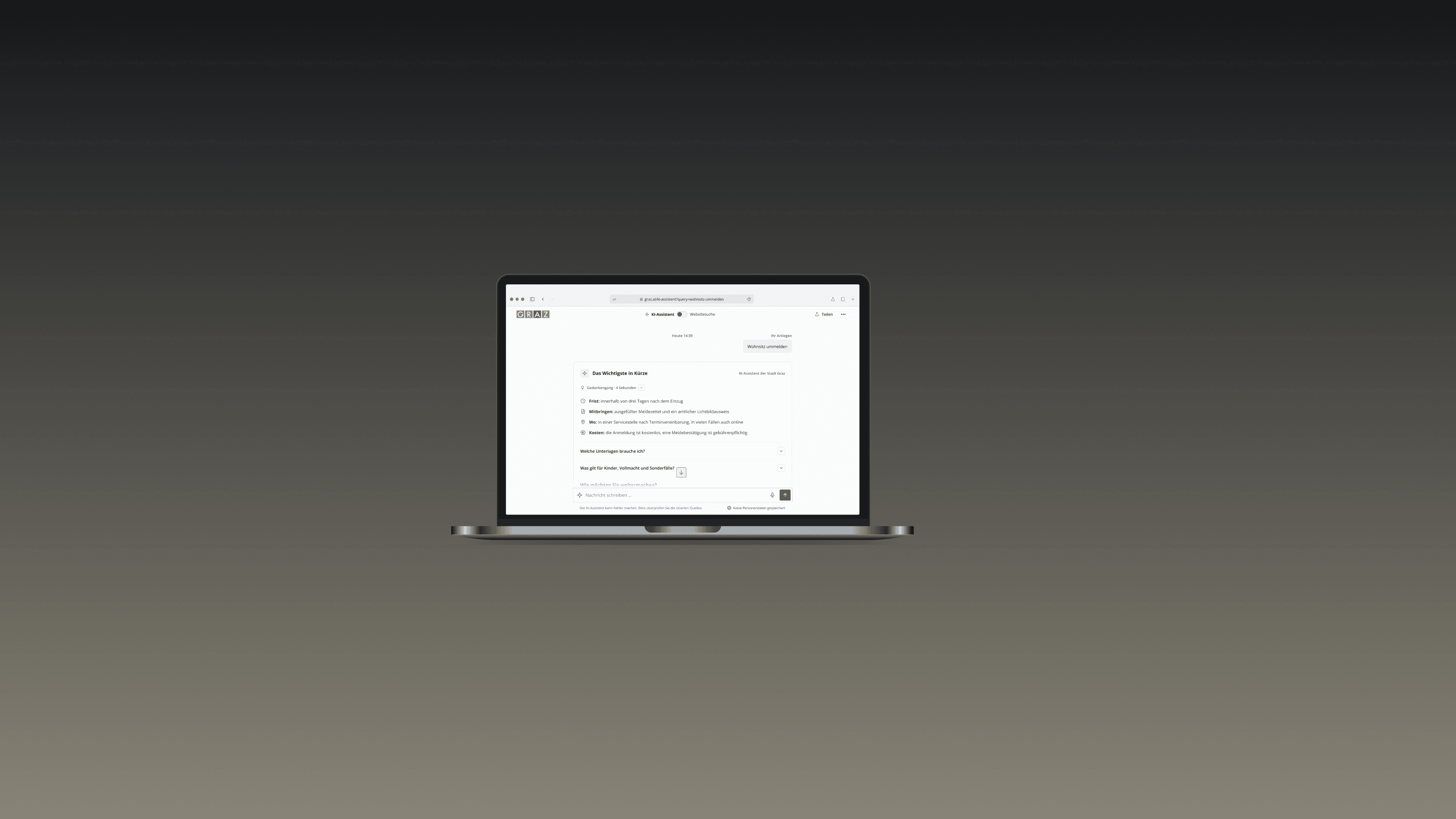
A low-threshold input field reduces AI skepticism by routing search terms to the site search and questions to the assistant. The assistant summarizes service information from official sources. A fixed prompt footer shows trust cues and data storage status, backed by transparency, role honesty, guardrails and a clear fallback to search or personal contact. An agentic design UI kit defines these patterns as reusable components.
UX Psychology within the City CD
The City of Graz corporate design allowed only a limited color and typography palette. Instead of relying on UI trends, I applied UX psychology: cognitive ease, few clear choices, familiar patterns, progressive disclosure and short click paths. A flat information architecture and life-situation entry points replace the administrative structure.
Accessibility
Accessibility was a baseline requirement, not a final check. All templates follow EN 301 549 and WCAG 2.2: sufficient contrast within the CD palette, scalable typography, visible focus states, keyboard navigation, semantic hierarchy and plain language. The AI assistant serves as an additional access route, never as the only one.
AI-Assisted Workflow & Planning
I iterated three templates in Claude Design, using Fable 5.1 for the homepage and Opus 5 for further pages, then imported them into Figma via MCP and html.to.design. The effort estimate covers workshop, concept, prototype, optional user testing and go-live, planned partly agile.